By mid-2025, 61% of global companies were accelerating investments in task and process automation, with even greater adoption among those affected by workforce aging and trade uncertainty.
Automation in the workforce generally falls into two major categories: industrial automation and software automation. Industrial automation leverages physical robots to perform manual labor in manufacturing and other production settings. Whereas software automation enhances HR and employee productivity and efficiency by delegating simpler digital tasks to smart machine partners.
While forms of automation – such as business process and robotic process automation – are already well-established, a new wave of intelligent tools is emerging. Intelligent automation tools such as agentic AI are likely to replace generative AI as the next workforce MVP. Where they once operated with only a limited store of information and required heavy oversight, today’s agentic AI bots can collaborate both with other technology systems and human workers with less supervision.
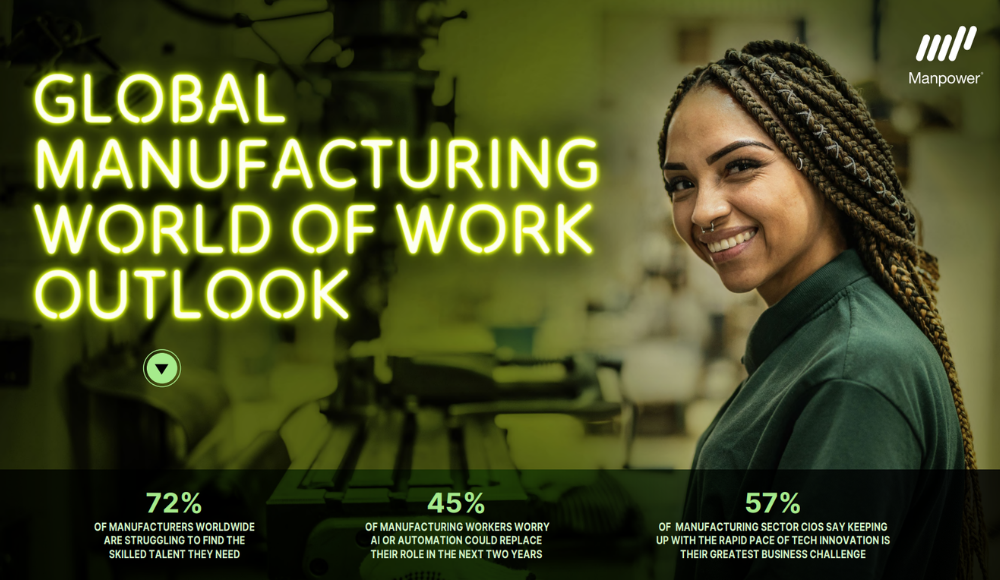
Despite the rapid evolution of automation technologies, employees are more concerned about economic instability (34%) than being replaced by AI or other automation technology (19%).
To successfully implement new industrial or software automation, leaders should focus on strategies that prioritize human-machine collaboration. Key recommendations include designing human-friendly systems, upskilling and empowering human colleagues, and measuring success beyond raw productivity.
In this paper from the ManpowerGroup Work Intelligence Lab, experts examine the evolving landscape of automation across global industries and the opportunities emerging technologies like AI offer to businesses worldwide.
Download the full whitepaper to explore actionable insights and strategies for navigating the future of workforce automation.
Download the full report